Advertised vs Reality on Etsy: How AI Photos and Bot Reviews Fake Trust in 2026
📑 Table of contents (9)
- What changed in 2026: the listing photo is no longer evidence
- The four common advertised-vs-reality patterns
- How to spot AI-generated product photos in 30 seconds
- How to detect bot reviews without a tool
- Is it illegal? What the FTC rule actually says
- If you already bought something that arrived wrong
- For honest sellers: how to look real when fakes look perfect
- The pricing trap: why fakes can undercut you, and what to do
- A 60-second buyer checklist you can actually remember
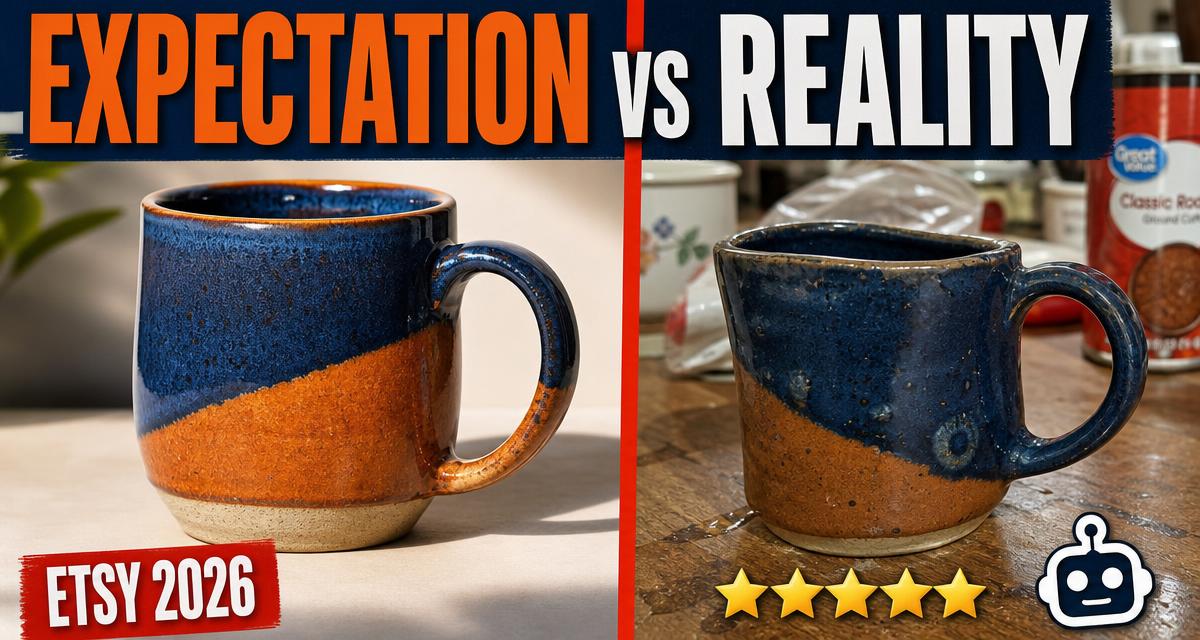
You order a hand-thrown ceramic mug that looked like museum pottery in the listing photos. It had 1,400 reviews and a 4.9 rating. What arrives is a crooked factory mug with a glaze bubble on the rim. Nothing in the listing was technically a lie — the photo was just never a photograph. In 2026 the fastest-growing form of false advertising on marketplaces is not fake text, it is <strong>AI-generated product imagery paired with machine-written reviews</strong>, and together they manufacture a false sense of security that is very hard to argue with at checkout. This guide breaks down exactly how the advertised-vs-reality gap is engineered, the concrete tells buyers can use in under 30 seconds, what the FTC's fake-review rule actually bans, and how honest sellers should respond — including the pricing math that makes honest listings survivable.
What changed in 2026: the listing photo is no longer evidence
For twenty years, a product photo was a weak but real proof of existence — somebody had to own the object to photograph it. Generative image models removed that. A seller can now type "handmade speckled stoneware mug, cobalt glaze, warm studio light, linen backdrop" and get a dozen flawless, consistent, brand-coherent images of a product that does not exist yet, has never been made, and may be drop-shipped from an entirely different factory.
That is the core of modern false advertising using AI: no false sentence is ever written. The description says "ceramic mug, 350ml, dishwasher safe" and all of it is true. The deception lives entirely in pixels — the glaze depth, the perfect handle curve, the artisanal wobble that reads as handmade. Consumer protection law is built around claims, and an image is a much slipperier claim than a sentence.
The second half of the machine is reviews. AI text generation made plausible five-star reviews effectively free, and review brokers now sell aged accounts with real purchase histories. The result is a listing that satisfies every heuristic a shopper has ever been taught: high volume of reviews, recent dates, specific-sounding detail, photos in the reviews. Trust signals stopped being scarce, and anything that is not scarce stops being a signal.
Etsy is a specific pressure point because its entire value proposition is human-made. The platform's handmade policy requires items to be made or designed by the seller, so a shop that fakes a workshop aesthetic is not just embellishing — it is competing on the exact attribute buyers came for.
The four common advertised-vs-reality patterns
1. The AI hero photo. The main image is generated; the rest of the gallery is generic supplier photos or the same generation re-cropped. What arrives is a real object, just a much cheaper one. Buyers rarely dispute this because they cannot prove the photo was fake, only that theirs "looks different in person".
2. The scale lie. Extremely common in prints, jewellery and wall art. AI staging renders a print at gallery scale over a sofa; the item is A5. The dimensions are in the description, and buyers do not read them because the render told them a story first.
3. The borrowed workshop. Shop banners, "meet the maker" portraits and studio shots are all generated. The person does not exist. This is the pattern with the most legal exposure, since a fabricated maker identity is a direct misrepresentation, not an aesthetic choice.
4. Review laundering. A listing with 900 reviews is reused for a completely different product. The reviews are genuine, but they belong to a $6 sticker pack, not the $60 lamp now occupying that listing. On the buyer's screen it renders as social proof for the lamp.
None of these need a criminal mastermind. They are what happens when a listing template, an image model and a review-generation service each shave a bit of honesty off, and the marketplace ranking algorithm rewards the composite.
How to spot AI-generated product photos in 30 seconds
Check the boring parts of the frame. Models render the hero object well and get lazy at the edges: text on packaging in the background turns to nonsense glyphs, plug sockets have five holes, wood grain flows through a table leg without interruption, a plant's stems merge into the pot.
Look for physically impossible light. A common tell is a product with soft studio wraparound light sitting in a scene with a hard directional window shadow, or a reflective object whose reflection does not contain the room it is in. Also watch for two shadows going different directions.
Count repeats. Generated sets are often five variations of a single scene rather than five views of one object. Real sellers photograph a top-down, a scale shot, a detail of the seam or glaze, and a packaging shot. If you never see the underside, the base, or the item in a human hand, be suspicious.
Ask for a shot that is hard to fake. Message the shop: "Can you send a photo of the actual item next to a ruler with today's date on a slip of paper?" An honest maker does this in an hour. A generated shop stalls, sends more renders, or replies with polished paragraphs that never contain a photo.
Reverse-image search the hero shot. Paste it into Google Images or TinEye. Two outcomes are both informative: the same image on twenty stores (supplier catalogue) or zero matches anywhere and no social footprint for a supposedly established maker.
Check C2PA / metadata where available. Some generators embed content credentials. It is not reliable — most marketplaces strip metadata on upload — but when it survives, it is decisive.
How to detect bot reviews without a tool
Read the distribution, not the average. Organic reviews form a J-curve: lots of 5s, a real tail of 3s and 1s. A listing with 1,200 reviews, 99% five-star and no one-star at all is statistically strange for a physical product with shipping involved.
Look at timing clusters. Forty reviews in three days, then silence for two months, then thirty more, is a purchase-burst signature. Genuine sales trickle with seasonality, not step functions.
Read the language, not the sentiment. Generated reviews are fluent, balanced, and oddly complete — they mention shipping speed, packaging, quality and the recipient's reaction in four tidy clauses. Real reviews are lopsided: they obsess over one thing, misspell it, and often say nothing about packaging at all.
Watch for the missing negative specific. Real happy reviews contain a tiny complaint ("took 11 days but worth it"). Bot reviews rarely risk a concrete negative, because they are optimised for star value.
Sort by lowest rating and read the one-stars first. If a listing is padded, the one-stars are where the truth about the actual object lives — and they usually all say the same phrase: "not as pictured".
Cross-check review photos. Buyer-uploaded photos are currently the strongest signal left, because they are shot badly, in bad light, on real tables. If a listing has 1,000 reviews and zero customer photos, that is the anomaly worth acting on.
Is it illegal? What the FTC rule actually says
In the United States, the FTC's Rule on the Use of Consumer Reviews and Testimonials bans creating, buying, or selling fake reviews and testimonials — including reviews written by AI attributed to people who do not exist — and bans review suppression and undisclosed insider reviews. Civil penalties can be assessed per violation, which is why review brokerage has moved offshore rather than disappeared.
For images, the older and broader tool applies: Section 5 of the FTC Act prohibits deceptive acts and practices, and a depiction that misleads a reasonable consumer about a material characteristic is a deceptive representation regardless of whether it was drawn, photographed, or generated. The medium is not a defence.
In the UK and EU the same conduct is captured by the Digital Markets, Competition and Consumers Act 2024 and the Unfair Commercial Practices Directive, both of which explicitly cover fake reviews and misleading presentation.
The practical gap is enforcement scale. Regulators pursue large operators; a single shop with 40 sales is handled by marketplace policy, not by the state. That is why buyer-side detection and the platform's own case system still matter more day-to-day than the law does.
If you already bought something that arrived wrong
Photograph the item the moment you open it, in daylight, next to something for scale, including the packaging and shipping label. Do not throw the box away — most "return at your cost" arguments hinge on packaging condition.
Message the seller first through the platform, not email. Etsy's case system requires a seller contact attempt, and messaging outside the platform destroys your evidence trail. State the mismatch in factual terms: "listing photo shows X, item received is Y" beats "this is a scam".
If there is no useful reply within 48 hours, open an Item Not as Described case under Etsy's Purchase Protection. Attach the side-by-side: listing screenshot and your photo in one frame is dramatically more effective than two separate uploads.
Keep the payment-provider chargeback as the last step, not the first. Filing a chargeback before a platform case can close the platform case automatically and sometimes leaves you with less protection, not more.
Leave the review after resolution and describe the object, not your feelings. "Listing shows a hand-thrown mug with visible throwing rings; received a machine-pressed mug with a mould seam" is the review that helps the next buyer and is very hard for a seller to get removed.
For honest sellers: how to look real when fakes look perfect
The uncomfortable truth is that generated listings now out-photograph genuine makers. Competing on polish is a losing race. Compete on verifiability instead — signals a generator cannot cheaply fake.
Show process, not just product: a 15-second clip of the item being sanded, stitched or packed does more for conversion in 2026 than another perfect hero shot. Include one deliberately imperfect photo — the real grain, the real seam — and caption it as such.
Put a scale reference in image two, every time, and state dimensions in the first line of the description. Half of all "not as described" disputes are size disputes, and they are entirely preventable.
Disclose AI where you use it. If your background is generated or your mockup is a render, say "mockup — actual item photos in images 3-6". Voluntary disclosure is becoming a trust signal in its own right, and it removes the strongest complaint a buyer could later make.
Never buy reviews, including "review exchange" groups. Beyond the legal exposure, platform detection now clusters accounts by behavioural graph, and shops get removed months after the purchase, when the revenue is already spent.
Then price so honesty is affordable. Real materials, real photography time and a real return rate all cost money — run your numbers through the Etsy Profit Calculator and confirm the floor with the Etsy Break-Even Calculator before you undercut a fake competitor who has no material costs at all.
The pricing trap: why fakes can undercut you, and what to do
A generated-listing dropshipper has near-zero fixed cost: no materials held, no photography, no failed batches, no studio. Their break-even is just supplier cost plus fees. Yours includes labour, waste, and the two hours you spent shooting. On raw price you cannot win, and matching them is how good shops die profitably-looking and then suddenly not.
Model it before you react. On a $38 item a US Etsy shop pays roughly 6.5% transaction plus about 3% + $0.25 processing plus the $0.20 listing fee — around $4.15 before a single material cost, and closer to $9.85 if the sale comes via Offsite Ads at 15%. Run your own version with the Etsy Fee Calculator so the number is yours, not an average.
The winning move is almost never a price cut; it is raising perceived certainty. Bundles, a stated dispatch date, a real return policy and a 30-second process video move conversion more than $4 off, and none of them are copyable by a listing that has no object behind it.
If you sell across platforms, check the fee spread too — the same product often nets very differently on Etsy versus eBay versus a Shopify store. Compare with the eBay Fee Calculator and the Shopify Profit Calculator before you decide where the honest version of your product is viable.
A 60-second buyer checklist you can actually remember
1. Sort reviews by lowest first and read three. 2. Check whether any review has a customer photo. 3. Reverse-image search the hero photo. 4. Look for a scale shot and read the dimensions out loud. 5. Check shop age and whether sales volume is plausible for that age. 6. Message the seller one specific question and judge the reply speed and specificity.
If four of those six come back clean, buy. If three or more fail, the discount is not a discount — it is the price of a dispute you will spend two weeks on.
And the single strongest rule in 2026: trust buyer photos over seller photos, and trust one-star reviews over the star average. Everything a seller controls can now be generated; the messy stuff buyers upload still cannot.
FAQs
Is using AI-generated photos on Etsy against the rules?
Using AI to generate the image of a product you do not actually make or sell as depicted is misleading and can breach both Etsy's handmade and prohibited-items policies and consumer protection law. Using AI for a background, a mockup or a banner is generally allowed if the actual item is shown honestly in other photos and any mockup is labelled as one.
How can I tell if an Etsy review is written by a bot?
Look for a near-perfect star distribution with no one-star reviews, clusters of reviews within a few days, fluent four-clause reviews that mention shipping, packaging, quality and recipient reaction in one tidy sentence, and an absence of customer-uploaded photos. Any two of those together is a strong signal.
Are fake AI reviews illegal in 2026?
Yes in the US. The FTC's fake reviews rule bans creating, buying or selling reviews from people who do not exist, including AI-generated ones, and allows civil penalties per violation. The UK's DMCC Act 2024 and EU unfair-practices rules cover the same conduct.
What do I do if an Etsy item arrives nothing like the photos?
Photograph it immediately with packaging, message the seller through Etsy, and if there is no resolution within 48 hours open an Item Not as Described case under Etsy Purchase Protection. Attach a single image showing the listing photo and your item side by side. Use a payment chargeback only as a last resort.
Why do fake shops have better photos than real makers?
Because generated images have no production constraints — no lighting setup, no failed shots, no real object with flaws. Real sellers should compete on verifiability instead: process video, scale references, buyer photos and disclosed mockups, which generated listings cannot cheaply reproduce.
Does Etsy remove listings that use fake AI photos?
Etsy removes listings reported for misrepresentation and reseller violations, but enforcement is complaint-driven and slow. Reporting the listing plus opening a case on your own order is faster and more effective than reporting alone.
How do honest sellers price against AI dropshippers?
Do not match their price. Calculate your true break-even including fees, materials, labour and return rate, then compete on certainty — dispatch dates, bundles, process video and real return policy. Use a fee and break-even calculator so the floor is a number rather than a feeling.